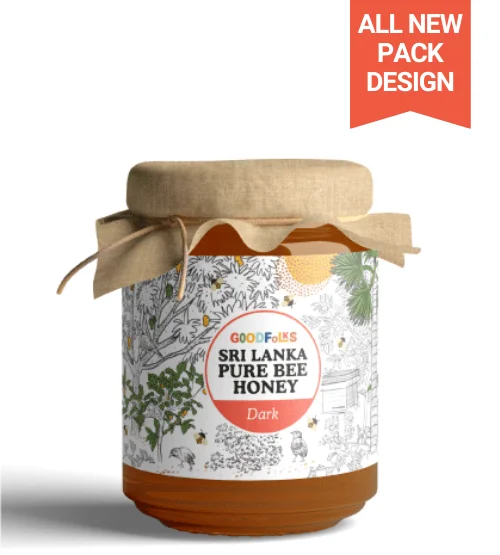
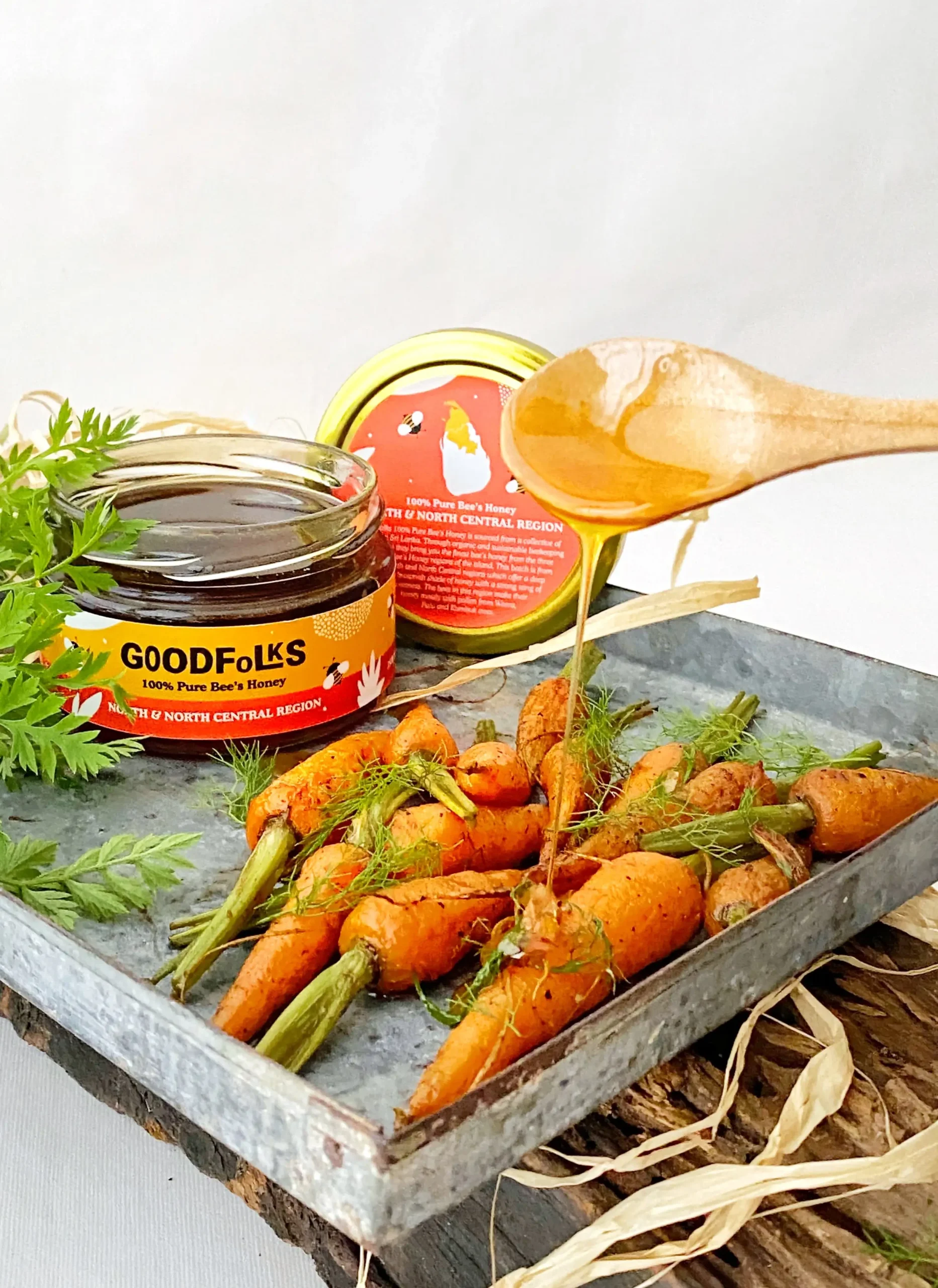
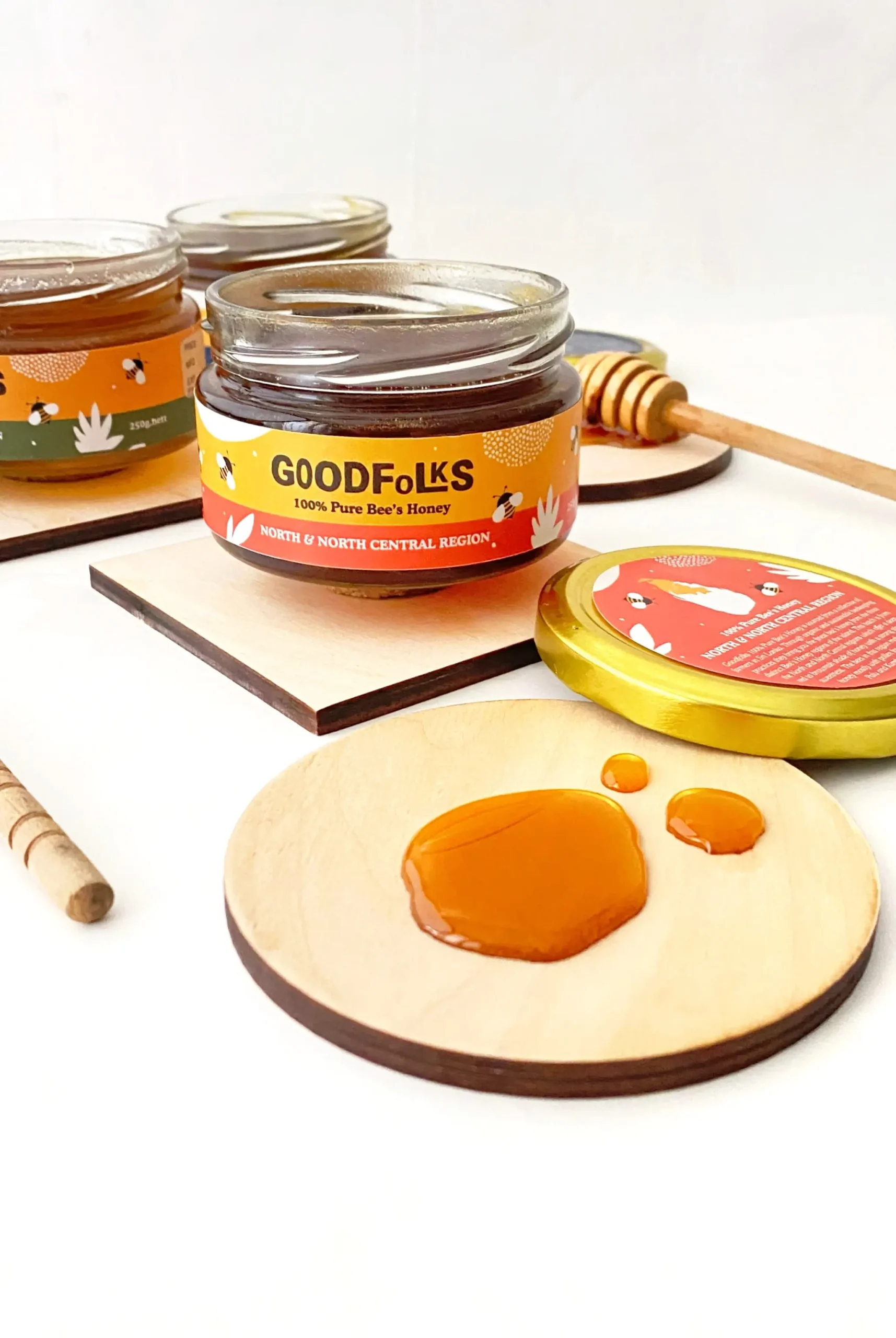
Sri Lankan Ayurvedic Bee Honey — Dark (Dry Zone)

100% natural, raw, filtered, pure Sri Lankan bee honey
  • Raw and unblended
  • Sourced from Sri Lanka’s North & North Central dry zone, home to Weera, Palu, Kumbuk and Mee — common pollen sources
  • Other pollen and nectar sources include tamarind, Kalawel, Kon and Nidikumba
  • Available year-round — the most abundant of the three
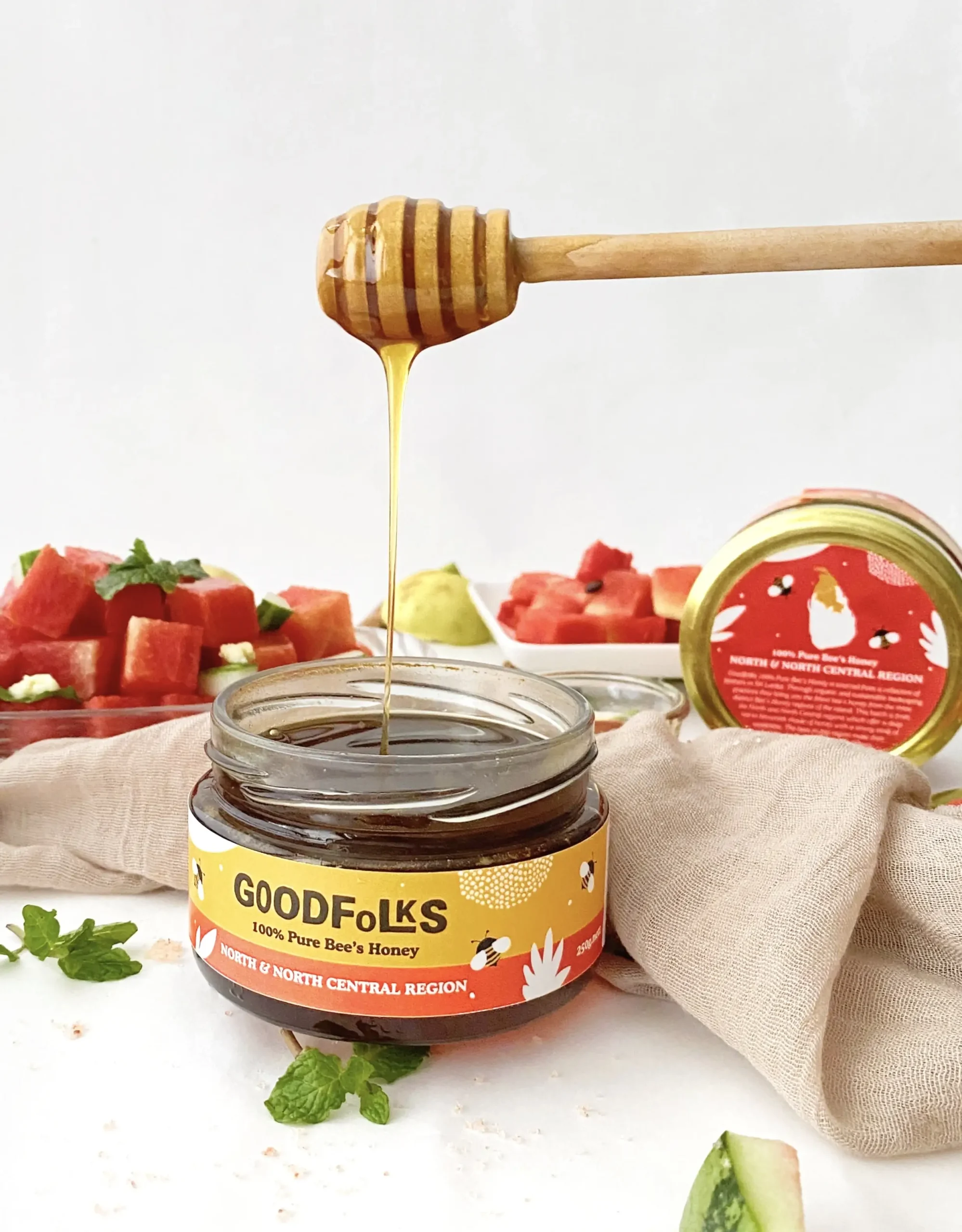
  • Deep red-amber, almost opaque, with a dense, thick texture
  • Treatment-free beekeeping (no synthetic chemicals at any stage)
  • Certified for quality by the Industrial Technology Institute (ITI)
  • Part of a Regenerative Agriculture Pilot Project by Good Life X
  • Sourced from a farmer network with attention to environmental and social impact
  • Quality verified at source using Brix refractometers
  • Farmers are paid above market rates and included in education & awareness programmes
  • No wild extraction · treatment-free · ITI quality-certified · farmers paid above market
Natural
Regenerative Agriculture
Eco Friendly

Description

Dark — the darkest and most intense, from the dry zone

The North & North Central dry zone is Sri Lanka’s largest climatic region — vast, hot and ancient. Its bees draw on the deep-rooted, hardy trees of this landscape, giving Dark a honey that is deep red-amber and almost opaque: bold, sharp and intense, with a faint bitter finish at the close. Like every honey in the collection it is rich with medicinal-plant pollen; Dark simply wears it as the darkest and most intense of the three.

Because our bees take from whatever medicinal trees are in bloom, no two batches are identical — each jar is a true record of its place and season. We don’t chase a uniform, homogenised honey; we celebrate the difference.

A note on the collection: Before 2020, Sri Lankan honey was sold as one undifferentiated product — one label, one price, no provenance. Goodfolks changed that, introducing the island’s first honey collection named by region. The conversation has moved since; we’re proud to have started it.


The truth behind all three regional varieties

Sri Lanka is one of the most biodiverse places on Earth — a recognised global biodiversity hotspot where close to 4,000 species of flowering plants grow, nearly 900 of them found nowhere else on the planet, packed into a small island. Few places weave plant life so densely. And because this island’s flora is bound up with a living, nationally recognised medical heritage, a great many of those plants are themselves medicinal.

This is what sets Sri Lankan bee honey apart. Where many honeys carry the character of just a handful of plants, Sri Lankan bees draw on hundreds of nectar sources — complex, nutrient-rich, and often medicinal. The result is honey that genuinely packs a punch: poly-floral, layered, and unrepeatable.

And we take it without ever taking from the wild. Stripping honey from wild colonies puts real stress on fragile forests; we don’t do it. Our farmer network keeps hives in home gardens and forest buffer zones, where the bees work amid this extraordinary plant life — protecting the wilderness even as it enriches the honey.

Here, honey is not a commodity. It is medicine, heritage, and survival. In Ayurveda and in Deshiya Chikitsa — Sri Lanka’s own indigenous medicine, carried down through generations and recognised by the state under the Department of Ayurveda — honey (mee pani) is among the most revered substances in the Ayurveda medicine cabinet. To the traditions of this island, honey is not a sweetener — it is a vehicle of healing. We say this plainly, as our healers always have.

And the bee sits at the very centre of these communities’ existence — not as a trade, but as a lifeline. The wilderness that has sheltered and fed Sri Lanka’s rural and indigenous people for thousands of years depends on the bee: the island’s agriculture, its forests, its biodiversity all turn on pollination, and the bee is its keeper. This is the circle we produce within — where people, plants and pollinators are held together, and farmers are the authors of the story, never its afterthought.

We are not here to replace the honeys the world already treasures — we are here to add one it has never tasted: the living island itself.
Impact

Goodfolks pioneered Sri Lanka’s Regional Bee Honey Collection in 2020 — the first time this honey was named, sourced by region, and presented with full provenance. We remain the primary source for buyers who want Sri Lankan regional honey with verified origin.

  • Farmers paid above market rates — quality is inseparable from the keeper’s care
  • Training and market access — we train keepers on harvesting and conservation, and open channels small keepers couldn’t reach alone
  • No wild colonies disturbed — every hive sits in a home garden or forest buffer zone
  • Treatment-free throughout — no synthetic chemicals, no antibiotics, at any stage
  • Regenerative agriculture — part of Sri Lanka’s first Regenerative Agriculture Pilot Project (Good Life X): ethical beekeeping that raises premium honey while improving biodiversity and soil health

Special Attributes

Among the world’s most medicinal honey

Sri Lanka’s indigenous healing tradition — Hela Vedakama — places honey at the centre of hundreds of formulations, not only for its own properties but for its rare quality of amplifying the substances it is combined with. This is why honey sits at the base of countless traditional preparations. In the Sanskrit classification of honeys, Makshika — the honey of Apis cerana, Sri Lanka’s primary honey bee — is named the finest medicinal honey.

Traditional applications (as held in Ayurveda & Hela Vedakama, documented by the University of Colombo): immunity & respiratory support (throat, asthma); digestive health; anti-inflammatory use (arthritis, arthralgia); wound healing (eczema, ulcers, skin); energy & recovery; cognitive support.

Where research echoes the tradition: higher total phenolic content and enzyme activity than honey from Malaysia, Thailand and India (Journal of Food Science & Technology); higher calcium, magnesium, potassium and iron (Journal of Food Composition & Analysis); broad-spectrum antibacterial activity against MRSA, E. coli and Candida albicans (University of Sri Jayewardenepura, 2024).

Rooted in Sri Lanka’s traditional medical systems and supported by published research.

Specifications

Product nameSri Lankan Ayurvedic Bee Honey — Dark (Dry Zone)
Part ofGoodfolks Regional Bee Honey Collection (first in Sri Lanka, 2020)
Bee speciesApis cerana
Source regionNorth & North Central Sri Lanka — dry zone
Primary pollenWeera, Palu, Kumbuk, Mee (+ tamarind, Kalawel, Kon, Nidikumba)
ColourDeep red-amber, almost opaque
FlavourBold, sharp, faint bitter finish
TextureDense, thick
SeasonAvailable year-round; the most abundant of the three
MoistureVerified by lab
ProcessingRaw · filtered (debris removed only) · never blended
AdditivesNone
CertificationQuality certified by the Industrial Technology Institute (ITI), Sri Lanka
AgricultureTreatment-free, regenerative
Formats60g · 300g · 1kg
Shelf lifeIndefinite when stored correctly
StorageRoom temperature, sealed, out of direct sun; crystallisation is natural and a sign of purity
ShippingFedEx available; ARAMEX via JOYUS coming soon

Sourcing

Where this honey comes from

Goodfolks sources this variety from a network of registered, trained small-scale beekeepers working in home gardens and forest buffer zones across the North & North Central dry zone.

  • Treatment-free beekeeping — no synthetic chemicals, no antibiotics, no shortcuts. The bees forage freely; hives are managed with minimal intervention.
  • No wild colonies disturbed — every hive sits in a home garden or forest buffer zone. We never source from wild hives.
  • Two-level quality verification — Brix refractometer testing at the point of collection (purity and water content, on the farm), plus larger-batch testing at the Industrial Technology Institute (ITI), Sri Lanka’s accredited national quality body.
  • Above-market payment — farmers are paid above the market rate; the quality of the honey is inseparable from the quality of the keeper’s care.

The sourcing standard — regional provenance, treatment-free practice, Brix verification at source, ITI testing — was set by Goodfolks in 2020 and applies to every batch since.

The Regional Collection

DarkAmberGold
RegionNorth & North CentralUva HighlandsSabaragamuwa
ColourDeep red-amberWarm amberPale gold
FlavourBold, sharp, intenseFruity, balancedSilky, delicate, buttery
PollenWeera, Palu, Kumbuk, MeeRed gum, Kudu Dawula, Savukku, Maara + orchard fruitRubber, kithul, Sri Lankan olive, Kon
AvailabilityYear-roundSeasonal — peaks Jul–DecSeasonal — peaks Mar–May
Best forDaily use, cookingEveryday, culinaryTasting, drizzling, gifting

You may also like…

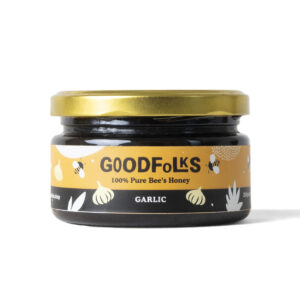
  • Sri Lanka Ayurvedic Bee Honey with Garlic

    Sri Lankan Bee Honey with Garlic

    Ayurvedic Blends for Health & Wellness
  • Sri Lanka Ayurvedic Bee Honey with Ceylon Cinnamon 1

    Sri Lankan Bee Honey with Ceylon Cinnamon

    Ayurvedic Blends for Health & Wellness
  • Sri Lanka Ayurvedic Bee Honey with Ginger 1

    Sri Lankan Bee Honey with Ginger

    Ayurvedic Blends for Health & Wellness
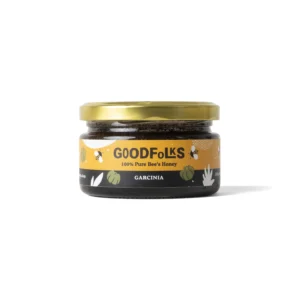
  • Goodfolks Ayurvedic Bee Honey Blend - Garcinia Cambogia - Pack View

    Sri Lankan Bee Honey with Garcinia Cambogia (Goraka)

    Ayurvedic Blends for Health & Wellness